
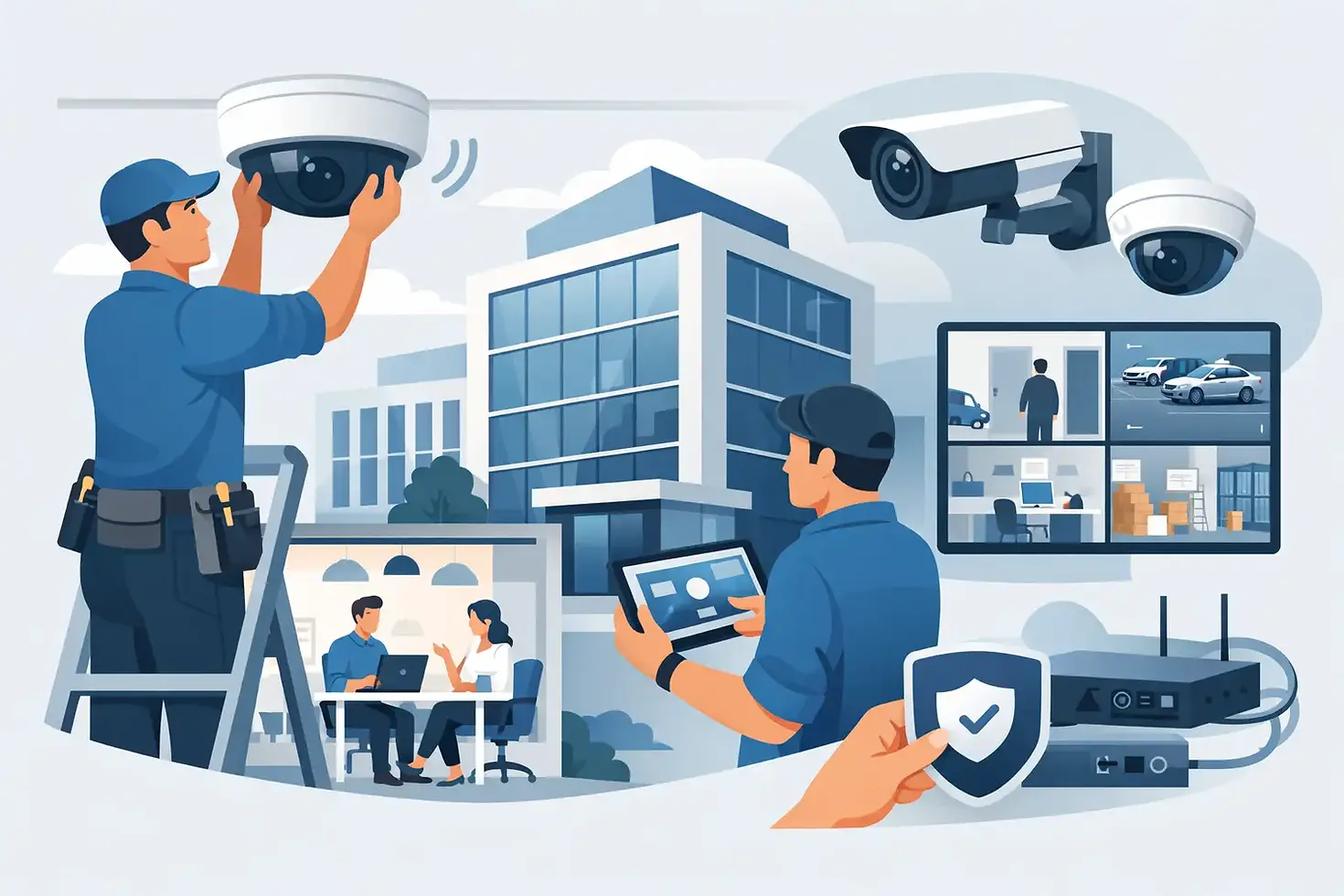
Business CCTV System Installation Explained
A camera above the front door is not a business security strategy. For most commercial sites, business CCTV system installation needs to do far more than record who came in and out. It should help deter theft, support staff safety, improve visibility across the premises and give management clear footage when something needs investigating.
That only happens when the system is designed around the building, the risks and the way the business actually operates. A warehouse, office, retail unit, school and hospitality site all need different coverage, different storage requirements and different levels of access. A good installation starts with those practical details, not with a box of cameras.
What a business CCTV system installation should achieve
The best systems are built around outcomes. For one business, that might mean covering delivery bays where stock regularly arrives and leaves. For another, it might be controlling blind spots in customer-facing areas, monitoring access points after hours or checking incidents in staff-only spaces.
Clear footage matters, but placement matters just as much. A high-spec camera in the wrong position can leave you with glare, blocked views or unusable images. That is why site planning is such a large part of effective business CCTV system installation. Entrances, exits, car parks, corridors, till areas, loading zones and perimeter lines all need to be assessed in context.
There is also a balance to strike between coverage and practicality. More cameras are not always better. If the layout is poorly thought through, a site can end up with duplicate views in low-risk areas and weak protection where it actually counts.
Start with the building, not the equipment
Every commercial property presents its own challenges. Ceiling height, external lighting, reflective surfaces, network availability and distance between buildings all affect what can be installed and how well it will perform.
A small office may suit a compact IP-based setup with remote viewing for management. A larger multi-zone site may need a more structured design with separate recording capacity, carefully planned network traffic and controlled user permissions. Outdoor areas usually require weather-resistant cameras and proper consideration of lighting levels after dark.
This is where experience matters. A tailored design avoids the common problem of businesses buying equipment that looks right on paper but struggles in day-to-day use. If a camera cannot capture a face clearly at a gate, or footage cannot be retrieved quickly after an incident, the system is not doing its job.
Choosing the right cameras for commercial use
Not every camera suits every environment. Dome cameras are often chosen for internal areas because they are neat, discreet and difficult to tamper with. Bullet cameras can work well externally where visible deterrence is part of the goal. Turret cameras are popular where reliable image quality and flexible positioning are needed.
Resolution is only one part of the picture. Lens selection, viewing angle, low-light performance and motion handling all play a part in whether footage is genuinely useful. A wider view can cover more ground, but it may reduce detail at distance. A narrower field of view can improve identification, but only in a defined area. It depends on whether the priority is overview, identification or both.
Night performance deserves special attention. Many incidents happen outside working hours, so external cameras need to maintain image quality in poor light. That may involve infrared capability, supplemental lighting or a different camera specification altogether.
Recording, storage and remote access
A commercial CCTV system is only as useful as its recording setup. Businesses need enough storage to retain footage for an appropriate period, and that period varies depending on the site, the volume of activity and internal policies.
Higher resolution cameras and longer retention times require more capacity. That sounds obvious, but it is often underestimated. If a business expects to review footage from several weeks ago, the recorder and storage design need to support that from the outset.
Remote access is also a major consideration. Owners and managers often want to view live or recorded footage from a mobile phone, tablet or desktop. When set up correctly, this can be extremely useful. It allows quick checks on openings and closures, deliveries, alarm activations or unusual activity. It also needs to be secure. Access permissions, password controls and network configuration should be handled properly, not left as an afterthought.
Compliance, privacy and responsible use
CCTV must be installed and used responsibly. For businesses, that means thinking beyond hardware and considering data protection, staff awareness and the lawful use of recorded footage.
Camera positions should be chosen carefully so the system covers what it needs to without overreaching. Signage, retention settings and access to recordings should all be considered as part of the installation process. The exact requirements depend on the business and the environment, but compliance should always be part of the conversation.
This is another reason to avoid one-size-fits-all packages. Commercial sites differ widely in layout and operational risk, and responsible installation requires proper planning, not guesswork.
Why integration often makes more sense
Many businesses now want CCTV to work alongside other systems rather than sit in isolation. That could mean linking surveillance with intruder alarms, access control, intercoms or the site network.
The advantage is practical. If a door event, out-of-hours access attempt or alarm trigger can be checked against camera footage quickly, response times improve and management has a clearer picture of what happened. For businesses operating across one site or multiple buildings, integration can also simplify day-to-day oversight.
There is a technical side to this too. CCTV relies on stable connectivity, and poor cabling or weak network design can lead to unreliable performance. Where security and IT requirements overlap, it often makes sense to use one specialist partner who understands both sides of the installation. That avoids gaps between contractors and helps the whole system work as intended.
Common mistakes businesses make
The first mistake is under-scoping the project. A business may focus on the reception area and front entrance while ignoring side access, delivery routes or internal choke points where incidents are more likely.
The second is over-buying without a plan. More devices do not automatically create better security. They can create more complexity, more storage demand and more maintenance, without improving actual coverage.
The third is treating installation as a one-off job. Cameras need to stay clean, aligned and operational. Recorders need to be checked. Firmware, remote access and storage health all need occasional review. Ongoing support is not an extra for many businesses - it is part of keeping the system dependable.
What to expect from a professional installation
A properly managed project should begin with a site survey and a clear discussion about risks, priorities and budget. From there, the system design should reflect the building layout, the level of coverage required and any need for integration with wider security or networking infrastructure.
Installation itself should be tidy, compliant and planned to minimise disruption. Cabling routes, device positions and recorder placement should be chosen with care. Once fitted, the system should be configured, tested and explained clearly so the customer understands how to use it.
Support after handover matters as well. Businesses need confidence that if settings need adjusting, footage needs retrieving or the site changes over time, help is available. That is one of the main advantages of working with an experienced provider rather than buying off-the-shelf equipment and hoping for the best.
For organisations across East Sussex, Kent and the wider Sussex area, this is where a service-led approach makes a real difference. Techie Installation Services Ltd designs and installs tailored CCTV and wider security systems around the needs of the site, with the technical capability to support both protection and connectivity in one place.
How to judge whether your current system is enough
If your cameras leave blind spots, struggle at night, produce poor playback quality or are difficult to access when needed, the system may no longer meet the needs of the business. The same applies if the building layout has changed, stock values have increased or there are more staff and visitors moving through the site.
A good CCTV setup should feel dependable. You should know what it covers, how to retrieve footage and who can access it. If any of that feels unclear, a review is worthwhile before a problem exposes the gap.
The right system is not always the biggest one. It is the one that fits the way your business works, protects the areas that matter most and continues to perform long after installation day. That is where careful design, quality equipment and responsive support earn their value.


Comments